Billy Briscoe is a boxing savant
By: George Hanson Jr., Esq.
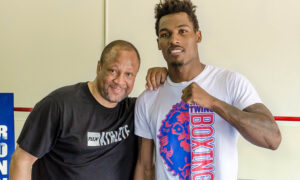
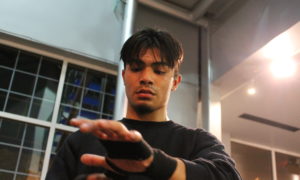
I have witnessed enough in this world—and experienced a depth of spirituality—to confidently say that Billy Briscoe’s presence feels timeless. It is as though he existed long before his official birth year, a spirit with deep roots in boxing’s storied past. Over the years, I have spent countless hours poring over photographs from the training camps of legends like Jack Johnson, Stanley Ketchel, and Joe Louis, searching for any hint of a familiar face resembling Briscoe in the background. While I have not found such evidence yet, my extensive conversations with him and my time observing him in the gym lead me to believe he is living his second life, as if he has been here before. Billy Briscoe is, without question, a boxing savant—a true student of the sport and a historian steeped in its rich traditions. His ability to recall the names, fights, and records of old-time boxers with astonishing accuracy convinces me that he has witnessed these historic bouts firsthand. Coach Kahlil Small often jokes that there are two people who, no matter the subject, will always steer the conversation back to boxing: myself and Billy Briscoe.
One of my most cherished memories with Billy occurred in November 2001, when we traveled together to Massachusetts by Amtrak from 30th Street Station in Philadelphia. I was accompanying Charles Ramey and his fighter, middleweight Willie “The Gladiator” Gibbs, who was preparing for his third professional fight. Also aboard the train was lightweight Aaron Torres and his trainer, Billy Briscoe; Torres was preparing for his eighth bout, both scheduled to fight on November 30th at Lombardo’s in Randolph, Massachusetts. We all sat in the same railway car, with Billy seated next to me. As the train departed from 30th Street Station, our conversation immediately turned to boxing—discussing old-time fighters and specific matches. The discussion lasted the entire six hours to Massachusetts, uninterrupted and lively. Many passengers appeared irritated but lacked the courage to ask us to quiet down. Regardless, we enjoyed a wonderful time, and our conversation continued seamlessly during the taxi ride to the hotel.
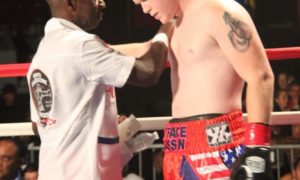
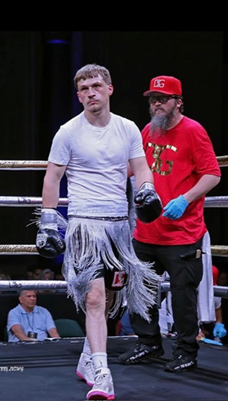
Briscoe is often seen on television as a trainer or cutman in fighters’ corners. His most memorable appearance was at Madison Square Garden on January 19, 2013, where he stopped the fight in the seventh round to protect Gabriel Rosado from further harm against Gennady Golovkin. Briscoe coached Rosado from amateur level to the #1 junior-middleweight contender, preparing him to face IBF Champion Cornelius Bundrage—a bout many expected Rosado to win and make Briscoe a world champion trainer. For some inexplicable reason – Rosado decided to forgo his shot at the junior-middleweight division – moving up a division to face arguably the most dangerous and deadliest fighter at the time – Gennady Golovkin (24 wins – 0 losses – 0 draw – 21 kos) WBA & IBO World Middleweight Champion. Bundrage was defeated a month later – February 23rd – losing the title by majority decision to Ishe Smith!
Billy Briscoe was born and raised in the Fairhill section of North Philadelphia, the only child of Willard Briscoe and Margaret. Willard, a master carpenter and World War II Army veteran who participated in the Normandy invasion, was sixty-two years old at Billy’s birth in 1974, while Margaret was seventeen years younger. Willard had also been a professional boxer and began training Billy in their basement when he was just six years old. Billy remembers fondly a pivotal childhood moment when his father allowed him to confront a school bully. Although his mother was not supportive of the idea, Billy handled the situation so well that the bullying stopped. Tragically, Willard passed away a year later, and Margaret brought Billy to Cambria AC (now Front Street Gym) so he could continue training.
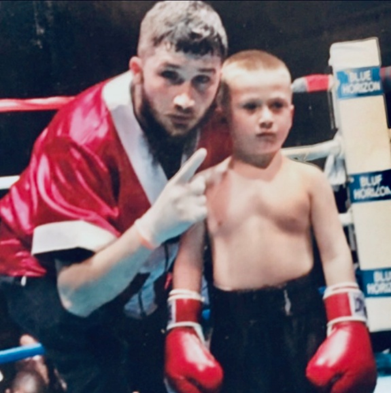
Billy spent four years training at Cambria AC before joining Dempsey’s Gym, where Wesley Mouzon mentored him. Under Mouzon, he focused on training others and developing cutman skills. He learned to treat cuts, train boxers, and quickly absorbed Mouzon’s boxing expertise. During this time, he helped trainer Whitman Burress at Harrowgate Boxing Club and at the age of fifteen decided to be a full-time trainer – his first student being his future brother-in-law, lightweight Charles “Chuckie T” Tschorniawsky. Chuckie T turned professional in 1995, retired in 2009 with a record of (25 wins – 10 losses – 1 draw – 14 kos), and was inducted into the Pennsylvania Boxing Hall of Fame in 2016. Briscoe also worked as a carpenter’s apprentice during summers.
Wesley Mouzon was born on August 15, 1927, in South Carolina and moved with his family to Philadelphia in 1933. He fought professionally from June 28, 1944, to November 26, 1946, achieving 26 wins, 3 losses, 1 draw, and 10 knockouts. Mouzon was a teen sensation, famously defeating lightweight world champion Bob Montgomery in a non-title bout by stoppage in the second round on August 19, 1946. Montgomery defeated Mouzon in their November 26th rematch, stopping him in the eighth round of a fifteen-round world title fight where Mouzon suffered a detached retina. The injury ended Mouzon’s boxing career at nineteen, after which he became a renowned trainer.
Briscoe attended Kensington High School but left due to boredom, later continuing his education at the Philadelphia Training Center. There, he expanded his skills to include plumbing and electrical work, having already mastered carpentry during his summer jobs. As a full-time trainer and master craftsman, he married his girlfriend Rosemary Tsschorniawsky in 1993. They have two children: Julia, age 31, and William Jr., age 26. William Jr. is a professional middleweight boxer with a record of (6 wins – 1 loss – 1 draw – 4 kos) and is regarded as one of Philadelphia’s top professional prospects, second only to light-heavyweight Atif “Lord Pretty Calvo” Oberlton, who boasts a record of (15 wins – 0 losses – 0 draws -13 kos).
It is no surprise that Billy and I share the same boxing lineage. My own training flourished under Charles “Cornbread” Ramey, who was mentored by the late, great Jimmie Arthur. Arthur, in turn, was trained by the legendary Jack Blackburn—the man credited with shaping Joe Louis into the second Black World Heavyweight Champion. Billy was trained and mentored by Wesley Mouzon, who also learned from Jack Blackburn. Thus, our boxing knowledge is rooted in one great tree: Jack Blackburn. Like myself, Billy is a voracious reader of boxing literature. As a child, he read “A Pictorial History of Boxing” by Nat Fleischer, widely regarded as the “Bible of Boxing” – my copy is on the bookshelf in my living room. He continues to study films of old-time boxers, further deepening his understanding and appreciation of boxing’s history.
Billy Briscoe holds the legendary World Heavyweight Champion Joe “The Brown Bomber” Louis in the highest regard among his favorite fighters. Louis, renowned for his technical brilliance and disciplined approach in the ring, was shaped by the teachings of Jack Blackburn. Briscoe admires how Blackburn transformed Louis into an exceptional fighting machine, capable of throwing crisp, precise combinations and maintaining impeccable defensive skills without any wasted movement.
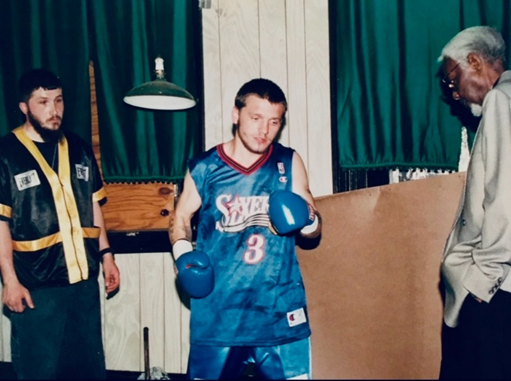
Alongside Louis, Briscoe’s list of vintage favorites includes Ezzard Charles and James Toney. He recognizes their mastery of boxing fundamentals, tactical intelligence, and adaptability as hallmarks of great fighters from earlier eras. Briscoe’s favorite current boxers are his son, Jaron “Boots” Ennis, and Jesse “Bam” Rodriguez. He values their high boxing intelligence, noting their ability to make strategic adjustments during fights while consistently dominating their opponents. Briscoe values both historical and modern fighters, recognizing their shared qualities across generations.
Briscoe has trained or assisted boxers like Aaron Torres, Bert Cooper, Sam Vargas, Dennis Hassan, Dusty Harrison, Sergio Melendez, Jose Medina, Joey Dawejko, Victor Vasquez and Danny “Swift” Garcia. He has served as cutman for many more. His impact on boxing is significant and deserves recognition for the Pennsylvania Boxing Hall of Fame. Despite his Amish-like appearance, he’s from Philadelphia’s badlands and lives by his motto: “I take life as a gift and I will ride it until the wheels fall off.”
Someday, I’ll find a photo proving his friendship with Jack Johnson and Stanley Ketchel.
Continue to support the sweet science, and remember, always carry your mouthpiece.
ghanson18@icloud.com